Kartik Shanker
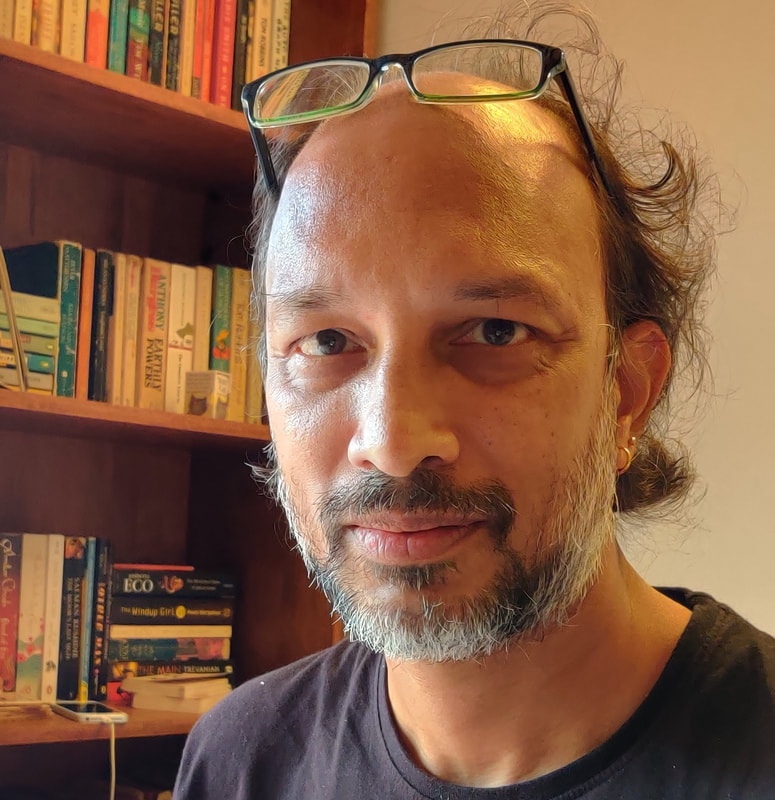
As faculty at the Centre for Ecological Sciences, Indian Institute of Science, I work on diversity at various levels of organisation, from genes to ecosystems, and at various scales from local communities to macro-ecological scales. We combine field ecology, phylogenetics and ecological modelling to understand evolutionary and biogeographic patterns in various marine and terrestrial taxa. We also work on the ecology and evolution of communities, particularly on mixed species foraging groups. We conduct research on the ecology and evolutionary biology of marine turtles and maintain long term monitoring programmes for species found in Indian waters.
I am working with my colleagues at Dakshin Foundation to develop and implement community based resource monitoring programmes towards more participatory governance of these resources, mainly in coastal and marine ecosystems.
Research news
Tracking leatherbacks
We have recently tagged two leatherback turtles using SPLASH tags from Wildlife Computers. Follow their journey here.
Some of our recent papers:
- Samad, I., D. Sutaria and K. Shanker (2026) Species rich but data poor: leveraging distribution modelling techniques to map cetacean occurrence around South Asian waters. Biodiversity and Conservation.
- Mbizah, M.M., T. Allen, S. Allred, D. Biggs, J.G. Bright Ross, A. Davalos, A. Dickman, M. Dunaway, R. Ghosh, M. Gomera, N. Hammond, D. Hare, T. Kepe, M.N. Nkomo, M.A. Oommen, K. Paudel, L. Rihoy, D. Roe, L. Rudd, K. Shanker & T. Thekaekara (2026) A framework for addressing racial and related inequities in conservation. Nature.
- Shukla, R., A.F. Eslava, N. Dahanukar, R. Raghavan, J.A. Johnson, V. Atkore, A. Bhat, M. Dornelas, A.E. Magurran and K. Shanker (2026) Geographical heterogeneity in how endemics shape ecological processes in a biodiversity hotspot. Proceedings of the Royal Society B.
- Dsouza, S., K. Shanker and M. Thaker (2025) Super predators or just super scary? A systematic review and meta-analysis of the behavioural consequences of human interactions with their "prey". Ecology Letters.
- Samad, I., D. Sutaria, E. Hines and K. Shanker (2025) Drivers of elasmobranch catch are site and fishery specific: Insights from a comparative assessment of fisheries across the east and west coasts of India. Ocean and Coastal Management.
- Petchiappan, A., A. Swaminathan, I. Samad, N. Namboothri and K. Shanker (2025) Across the Indian Ocean: post-nesting migrations of leatherback turtles from Little Andaman Island in the Bay of Bengal. Endangered Species Research.
- Srinivasan, U., K. Shanker and T. Price (2024) Ant impacts on global patterns of bird elevational diversity. Ecology Letters.
- Cyriac, V.P., A.V. Mohan, K.P. Dinesh, V. Torsekar, A. Jayarajan, P. Swamy, S.P. Vijayakumar and K. Shanker (2024) Diversifying in the mountains: spatio-temporal diversification of frogs in the Western Ghats biodiversity hotspot. Evolution 78: 991–1006.
Research themes
Diversity and distribution
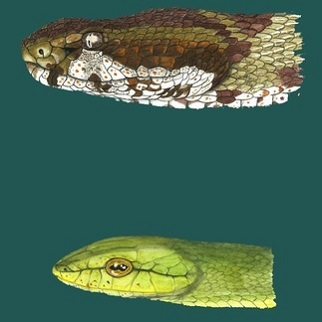
We work on the diversity and distribution of a range of taxa at multiple spatial and temporal scales. We are also interested in large scale altitudinal and latitudinal patterns using integrated models which incorporate neutral theory, ecology and evolution. Our current research includes studies of distribution patterns of birds and plants, and phylogeny and biogeography of snails, frogs, lizards and snakes.
Mixed species foraging
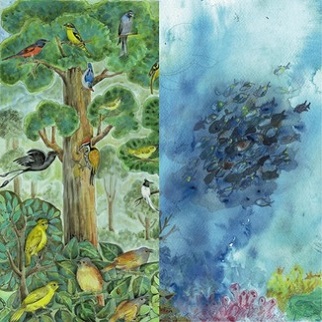
We are examining the role of positive interspecific interactions in structuring biological communities. Research in our lab focuses on different kinds of interactions including mixed-species foraging groups. We examine the costs and benefits of hetero-specific grouping in diverse systems from bird flocks in tropical forests to schools of marine reef fish.
Marine turtle biology
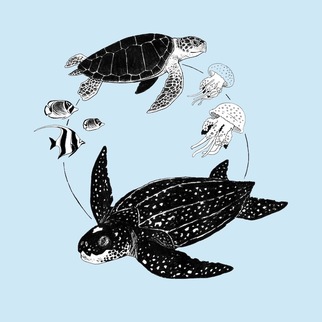
I started conducting research on sea turtles in 1999 with a project on the molecular ecology of olive ridleys in Odisha. Since then, my team has established long-term monitoring programmes for olive ridleys in Rushikulya (Odisha) and leatherback turtles in the Andaman and Nicobar Islands. More recently, we have started work on green turtles in the Lakshadweep Islands.
We work on the diversity and distribution of a range of taxa at multiple spatial and temporal scales. We are also interested in large scale altitudinal and latitudinal patterns using integrated models which incorporate neutral theory, ecology and evolution. Our current research includes studies of distribution patterns of birds and plants, and phylogeny and biogeography of snails, frogs, lizards and snakes.
I started conducting research on sea turtles in 1999 with a project on the molecular ecology of olive ridleys in Odisha. Since then, my team has established long-term monitoring programmes for olive ridleys in Rushikulya (Odisha) and leatherback turtles in the Andaman and Nicobar Islands. More recently, we have started work on green turtles in the Lakshadweep Islands.